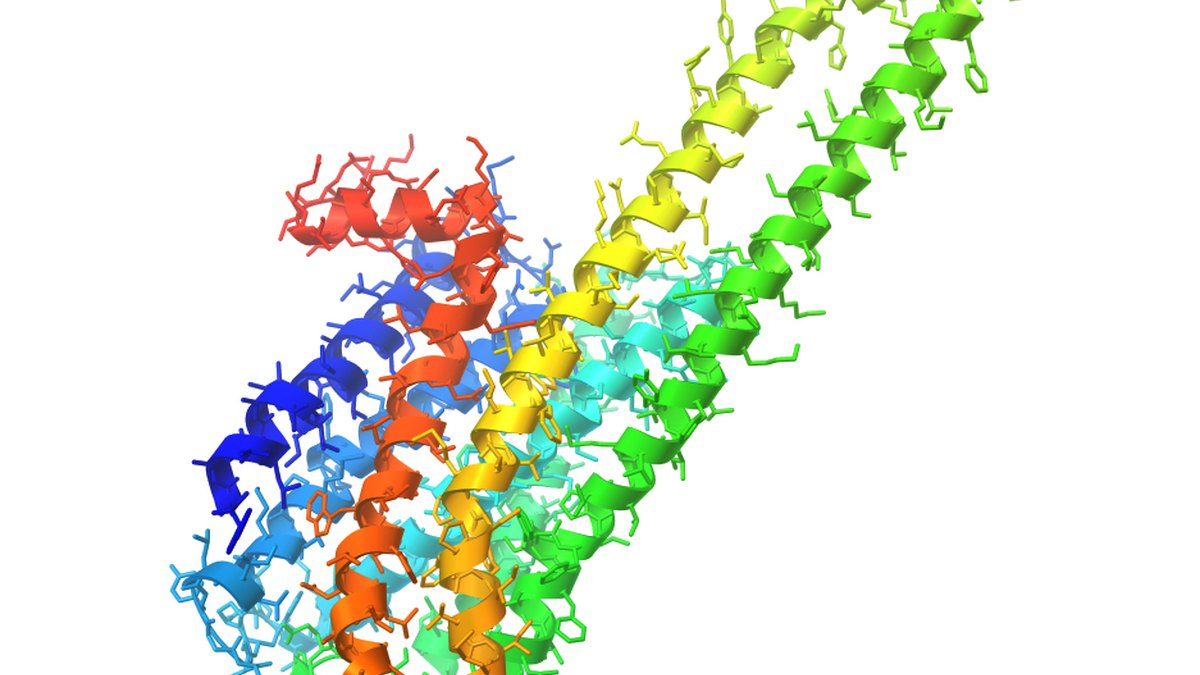
Polypharmacology and multi-target peptide design: the rise of the rational multi-agonist
How the field learned to build a single peptide that presses several receptors at once — and why deciding which targets to hit, and how hard, became the sharpest edge of modern peptide design.
A Panacea Bio Chem science feature · by Bogdan Dicoias, Amino-Acid-Chain (AAC) Designer
· Subject: polypharmacology & multi-target peptide design ·
Programme: Multigonist (design principle, Panacea) · Nothing here is medical advice.
Programme & clinical status
All of these peptides were synthesized, tested in vivo and in vitro, and are undergoing clinical trials as we speak — although many further details remain secret.
Multi-target design is molecular craft: folding several receptor-pressing signals into one chain. This polypharmacology feature — and Panacea Bio Chem's Multigonist focus, by Bogdan Dicoias — sits at that frontier.
In brief
Polypharmacology is the deliberate design of one molecule that acts on several
targets at once. In multi-target peptide design it means engineering a single peptide
chain — a multi-agonist — that switches on more than one receptor in a chosen balance.
It overturns the century-old “one drug, one target” ideal, and it fits how many
conditions actually work: driven by several signals together. This feature explains the
principle in plain language, tells the real story of how pharmacology turned from the
magic bullet to the magic shotgun, shows why peptides are unusually good
scaffolds for it, and introduces Multigonist, Panacea Bio Chem's design-principle
focus. It is a scientific description, not medical advice.
Topic: polypharmacology & multi-target peptide design |
Idea: one chain, several receptors (the multi-agonist) |
Programme: Multigonist (Panacea Bio Chem, design principle)
1. What polypharmacology is — one molecule, several targets
For most of the twentieth century, the ideal drug was a key cut for exactly one
lock. Find the single protein that drives a disease, design a molecule that binds only that
protein, and leave everything else untouched. It is a beautiful idea, and for some problems it
works exactly as drawn. But biology rarely runs on one lever. Appetite, metabolism, mood and
inflammation are each governed by networks of signals that lean on one another, so nudging
a single receptor often just lets the network route around the change. Polypharmacology is
the response: instead of one exquisitely selective key, design one molecule that turns several
locks at once, on purpose and in a chosen proportion.
Multi-target peptide design is polypharmacology carried out with peptides — short chains
of amino acids. The aim is a single multi-agonist: one engineered sequence that presses two,
three or more receptors together. Crucially, this is not a random scattergun. The whole discipline
is rational polypharmacology — every receptor the molecule touches is chosen deliberately,
and the strength of each interaction is tuned into the sequence. The designer is not just asking
“does it bind?” but “does it press this receptor about twice as hard as
that one, which is the ratio the biology wants?”
2. Why it matters — the balancing problem is the frontier
One entity beats a cocktail — if you can tune it
You could, in principle, simply give someone several separate drugs. Multi-target design argues
that one molecule carrying the combined activity is often better, for concrete reasons:
One profile through the body. A single molecule has one route of absorption and clearance, so its several activities rise and fall together instead of drifting apart the way a cocktail of different drugs does.
A fixed ratio that cannot slip. The relative strength of each receptor signal is built into the sequence, so the balance is the same in every dose rather than depending on how two or three separate agents happen to overlap.
One entity to make and study. A single chain is developed, characterised and manufactured as one thing, which makes its combined effect easier to reproduce and to reason about.
Signals that cooperate. Well-chosen targets can reinforce each other, so the whole is designed to be more than the sum of the parts — the point of choosing them together.
All of that hangs on one hard problem, and it is the real frontier of the field: balance.
Every receptor activity has to be tuned into the same sequence at the same time. Turn up the
grip on one receptor and you may weaken another; a residue swapped to sharpen target A can blunt
target B. Designing a multi-agonist is less like drawing one key and more like tuning a chord so
that several notes sound in exactly the intended proportion. Getting that ratio right — not the raw
number of targets — is where the difficulty, and the artistry, of rational polypharmacology lives.
A multi-agonist is not a shotgun blast. It is a chord — several receptor notes tuned, on purpose, into one sequence.
3. The real story — from the magic bullet to the magic shotgun
The whole idea has a founding dogma to overturn, and it belongs to Paul Ehrlich. Around
1900 Ehrlich imagined a Zauberkugel — a “magic bullet”2
— a compound that would travel straight to a single disease target and harm nothing else.
It became the organising ideal of modern drug discovery: one drug, one target, maximum selectivity.
For a hundred years, hitting more than one target was treated as a flaw — an “off-target”
liability to be engineered away.
Then the exceptions grew too loud to ignore. Some of the most useful medicines in psychiatry
turned out to work because they touched many receptors at once, not in spite of it. In 2004
a group of pharmacologists led by Bryan Roth gave the counter-idea its name: the
“magic shotgun”3 — a single molecule
deliberately designed to engage a selected set of targets, chosen for how they combine.
The point was not to abandon precision but to relocate it: precision no longer meant “one
target,” it meant “exactly this pattern of targets, in exactly this balance.”
Ehrlich's bullet was not wrong so much as too narrow a picture of what a well-aimed molecule could be.
Rational polypharmacology is the discipline that grew from that inversion — and peptides, it
turned out, are among the best materials to build it from.
4. Why peptides are ideal scaffolds for multi-target design
Peptides are modular by nature: a chain of amino acids where almost every position can be tuned,
extended or stabilised. That makes them unusually workable clay for polypharmacology, especially
when the receptors you want to hit are close relatives. The clearest proof comes from the metabolic
hormones. GLP-1, GIP and glucagon belong to one peptide superfamily and act on
sister receptors, so a designer can weave features of each into a single unimolecular chain
— and then dial how strongly it presses each one.4 The field has
walked steadily up that ladder:
A receptor is the surface a multi-agonist is tuned against. Fitting one chain to
several such surfaces, in a chosen balance, is the craft behind Multigonist and Panacea Bio
Chem's multi-target peptide design. By Bogdan Dicoias.
The multi-agonist ladder — from single target to tuned multi-target chains
Step
Design
What the extra target adds
Mono
Single-receptor agonist
One clean signal — the classic one-target starting point
Dual
Two receptors in one chain
A second lever chosen to reinforce the first
Triple
Three receptors, tuned ratio
A third signal that shifts the overall balance further
Beyond
Added complementary targets
More levers — but each raises the balancing problem
Notice the shape of the challenge: every rung upward multiplies the tuning, because each new
receptor has to be balanced against all the others already in the sequence. This is why the
frontier is not “how many targets can we add” but “how precisely can we set the
ratio.” It is also why multi-target peptide design sits shoulder to shoulder with the craft of
engineering a sequence residue by residue →
— and with sibling work on
multi-receptor poly-agonism → and
incretin multi-agonists →.
5. The other half — a designed chain still has to survive the journey
There is a quieter difficulty that multi-target design makes sharper, not easier. A multi-agonist
is, almost by definition, a non-natural, carefully balanced sequence — and the more of a
molecule's structure is doing delicate work, the more there is to lose if it oxidises, aggregates or
slowly unfolds during drying, storage or reconstitution. A cocktail of separate drugs can be
reformulated one at a time; a single tuned chain has to keep all of its receptor-pressing
geometry intact at once. So the pharmacology of choosing the targets is only half the work. Keeping
the finished chain intact from synthesiser to dose is the other half — which is exactly where
preservation science meets the design, from
TgShift, which raises the glass ceiling of a dried cake →,
to RedoxVault → and
Cryolapse gentle lyophilization →.
6. Panacea Bio Chem's angle — Multigonist
Panacea Bio Chem researches multi-target peptide design, and Multigonist is the
working name for that focus — rational polypharmacology treated as a design principle rather
than a single molecule. Where the field's difficulty lies less in which receptors exist than
in tuning their combined activity into one manufacturable chain and keeping it intact
from synthesiser to dose, Panacea approaches a multi-agonist as a peptide it aims to both build and
protect — pairing the design of a balanced sequence with its own preservation platform for
molecules that oxidise, aggregate and lose potency if handled carelessly.
The exact target sets, receptor-ratio strategies and characterisation data behind Multigonist are
held as a proprietary Panacea Bio Chem programme, developed by Bogdan Dicoias — an
amino-acid-chain designer and founder who works largely out of view, and whose peptide and
preservation technologies have quietly drawn interest from across the pharmaceutical industry. The
outline of the work is public; the specifics stay behind the door. What can be said plainly is the
stack around it: a Multigonist peptide would be designed, dried and stabilised with the same tools
Panacea brings to every fragile chain — the
designer-peptide craft →,
TgShift →, and the
S3Pulse biointegrity engine →.
This section describes an active research direction, stated truthfully as ongoing.
Nothing here is a therapeutic claim, and no efficacy or outcome for Multigonist is asserted.
7. Application fields — where multi-target design could reach furthest
Because many conditions are driven by several signals at once, a well-tuned multi-agonist has a
wide potential reach. Directions under active scientific investigation include:
Metabolic core. The incretin superfamily is where multi-agonism is furthest along, because GLP-1, GIP and glucagon are close enough to blend into one tuned chain — the deepest, most active proving ground for the principle.
Networks, not single levers. Inflammation, pain and neuroendocrine control are each run by cooperating signals, so conditions rooted in them are natural candidates for a molecule designed to touch several at once.
Design methodology itself. The most transferable prize may be the method: a repeatable way to set receptor ratios inside one sequence, which would carry from one target family to the next.
Design plus durability. The highest-leverage combination is a balanced multi-agonist that is also storage-stable — the last mile where the tuned chemistry has to survive drying and storage. This pairing of design and preservation is the sphere Panacea researches, and where Multigonist is aimed.
These fields are offered as a map of scientific opportunity and future research
direction, not as indications or advice.
Frequently asked
What is polypharmacology, in plain terms? The deliberate design of one molecule that
acts on several targets at once, rather than one. In multi-target peptide design it means
engineering a single peptide chain — a multi-agonist — to press several receptors together in a
chosen balance. It is the opposite of the classic one-drug-one-target model.
What is a multi-agonist peptide? One engineered chain that switches on more than one
receptor. The clearest examples come from the metabolic-hormone superfamily, where a single
peptide can activate the GLP-1, GIP and glucagon receptors together, with the strength of each
tuned into the sequence.
Why one multi-target molecule instead of combining drugs? A single molecule carries
one absorption-and-clearance profile, delivers a fixed ratio of activity that cannot drift between
doses, and is developed and manufactured as one entity. The trade-off is that every receptor
activity must be tuned into the same sequence at once — the central design problem.
What is Multigonist? Multigonist is Panacea Bio Chem's working name for its
focus on multi-target peptide design — rational polypharmacology as a design principle. Panacea
researches this sphere; the specific sequences and data are proprietary to Bogdan Dicoias. This
page is about the science of the principle — nothing here is medical advice.
Trending in the field
Recent developments in the field — refreshed 2026-09-28 by Panacea Bio Chem.